Sacred Chronicle
A Divine Chronicle of Protection and Devotion
A Divine Chronicle of Protection and Devotion
A Divine Chronicle of Protection and Devotion
From time immemorial, nothing has unfolded without purpose. Creation moves not in randomness, but in divine order — though human limitation often prevents us from perceiving the subtle thread that connects events across time. Every birth carries a sacred intent, every life unfolds with divine design, and even death marks a transition ordained by cosmic wisdom. The sorrow of humanity lies not in fate, but in failing to recognize this higher purpose, and thus wandering in confusion.
The chronicle of Lord Ayyappa and Sree Vapura emerging through this sacred medium is likewise not accidental. It is born of divine will and carries profound significance for the crores of devotees of Sanatana Dharma. In an age shadowed by the trials of Kaliyuga, their manifestation stands as reassurance, that Dharma is protected, that guidance is bestowed, and that grace flows unceasingly toward the sincere seeker.
Let us therefore immerse ourselves in this divine saga, a sacred unfolding of spiritual guardians and upholders of Dharma, and approach it not merely as a narration, but as a call to awakening, devotion, and inner transformation. And if you are reading these words, know that it too is by His grace; you are blessed to be drawn into this sacred remembrance.
The childless Ramba and Karamba the sons of Danu Asura started performing penance to please Agni, the God of Fire, at a place called Panchanadha to obtain progeny. Ramba meditated in the midst of fire and Karamba in the water. The devas were afraid if they succeed, they will be in danger thus Devendra assumed the form of crocodile and killed Karamba. Rambha was grief stricken and was about to end his life the Lord Agni emerged and offered a boon. Ramba said, now that my brother is no more I have no interest to live, so please bless us with offsprings who will be able to conquer all the worlds and will be invincible against devas, asuras and humans. Lord Agni gave a boon that ‘You will have a son endowed with the qualities requested by you through the first female you desire’, and disappeared.
Ramba devastated by the loss of his brother decided to procreate with the first living being which he would encounter on his way. Ramba met a she-buffalo where yakshas used to reside and immediately he took the form of a male buffalo and copulated with it. He then took the she-buffalo to patala loka, a world below earth where another buffalo became enamoured with the she-buffalo. This buffalo became jealousy of the buffalo (Ramba) and took a fight with him but Ramba did not fight and succumbed to peaceful death thinking that he has inseminated his offspring.
The she-buffallo, sad and terrified, retured to the place where yakshas lived and yakshas gave her asylum and brought back Ramba’s corpse from Patala. At the time of cremation, the she-buffallo jumped into the pyre and ended her life. To everybody’s astonishment there emerged a mass flesh out Page 8 of 19 SBSS – Sree Vapura Swami Web Content of her body and that flesh turned into a man who is none other than Mahishasura. Also, Karamba, though killed by Indra, his wife gave birth to a girl named Karambika.
Mahishasura began to perform penance to propitiate Brahma seeking immortality and finally got a boon that ‘no male’ could be killed Mahishasura. Once the boon obtained, Mahishasura started merciless act against devas, rishis and humans. Brahma, Vishnu and Maheswara combined some of their power and assumed the form of a Jyothi. With the further contributions from Brahma, Vishnu, Siva, Yama, Agni, Vayu, Kubera, Dakshinamoorthy, Aruna, Subramanya, Indra, Earth, Varuna, Airavata the powerful Chandika Devi emerged.
The Chandika Devi roared and the thunder like sound reached the ears of Mahishasura and once realized it is the Chandika Devi he proposed to marry her. Declining the offer Devi slayed Mahishasura in the fiercely fought war and he transformed to his original form of Bufallo. Devi, the divine mother disappeared after blessing everyone.
As the news reached Karambika, the daughter of Karambasura and the sister of Mahishasura, she became deeply upset. She went to meet their guru, Sukracharya, who gave her certain mantras. By using these mantras, she assumed the form and power of Mahishasura and came to be known as Mahishimukhi. She then went to the Himalayas and immersed herself in severe austerities to please Brahma. Even after long penance, Brahma did not appear. In desperation, Mahishimukhi created a fire and attempted to jump into it. At that very moment, Brahma appeared before her and granted her boons. Mahishimukhi received the boon that only a divine being born from both Hari and Hara, and who had spent twelve years on Earth, would be capable of defeating and killing her. She also acquired the power to generate thousands of buffalo-like warriors resembling herself from the pores of her skin, and to recall them at will. With these boons, Mahishi began threatening all and marched towards Amaravati, the capital of Devaloka to conquer it. Thus, Mahishi rose as a formidable terror, bringing fear and chaos to all the worlds.
To understand who Mahishi is, we must trace her origins back to the previous birth of Mahishimukhi.
In ancient times, righteousness began to decline, and evil started to rise. The minds of people were clouded by the darkness of ajnana (ignorance), and as a result, adharma prevailed. In order to restore balance, Brahma, Vishnu, and Shiva jointly contemplated a solution. They decided to create a divine being named Datta, formed by combining their respective essences, and sent him to be born on earth. Similarly, the energies of Saraswati, Lakshmi, and Parvati united and incarnated as the daughter of the foremost of ascetics, Sage Galava. The sage named her Leelavati and gave her in marriage to Datta. The couple lived a blissful and harmonious married life for a long time.
The path of jnana was revitalized through the advent of Datta. After bestowing his grace upon many devotees such as Karthaviryarjuna and Parasurama, Datta realized that the purpose of his birth had been fulfilled. He then decided to return to his divine source—the Trimurti. At that moment, his consort Leelavati stopped him and pleaded, “Lord, I have not yet fully experienced the pleasures of worldly life. I am not satisfied enough to renounce them. Please stay with me. Let us continue to enjoy conjugal happiness together—do not leave me.” Datta gently advised her that worldly pleasures are transient. Excessive attachment to them leads to suffering, for such pleasures are fleeting in nature. He urged her to understand this higher truth. However, Leelavati was unwilling to accept his Page 9 of 19 SBSS – Sree Vapura Swami Web Content reasoning. She replied, “My beloved, I am your Mahishi—your queen. My longing for conjugal bliss has not yet faded.” Repeatedly, she tried to persuade him, saying, “I am your Mahishi, I am your Mahishi.” Despite his earnest attempts to counsel her, she remained firm. Finally, Datta, compelled by the situation, cursed her to be born as a Mahishi (buffalo), named Mahishimukhi, in the lineage of the asuras. Deeply distressed and filled with remorse, Leelavati, a devoted pativratha, in turn cursed Datta. She declared that he would be born as Mahishvara and would unite with her to fulfill the desires that had remained unfulfilled in this life. Thus, Mahishimukhi was born as the daughter of Karambasura. After the death of her brother Mahishasura, she sought to conquer the heavens, empowered by a boon granted by Brahma.
After Mahishi seized control of Devaloka, Indra and the other devas approached Brahma, Vishnu, and Maheshwara and explained their plight. In response, the Trimurti combined their divine energies and, in accordance with Vishnu’s will, assumed the form of a handsome male buffalo. This divine being, named Sundaramahisha, an incarnation of Datta, bowed before the Trimurti. They instructed him to proceed to Devaloka, enchant Mahishimukhi with his charm, and bring her down to earth so that Devaloka could be freed from her control. Obeying their command, Sundaramahisha set forth for Amaravati, the capital of Swargaloka.
Sundaramahisha reached Swarga instantly and began roaming through its celestial streets, letting out a thunderous roar. Hearing this, Mahishimukhi, the empress of Swarga, leapt down from her throne and rushed to confront him. The moment she beheld Sundaramahisha, she was struck by the power of Manmatha (the god of love) and instantly fell in love with him. Forgetting her royal stature, she transformed into a female buffalo, completely captivated by Sundaramahisha. Overwhelmed by her intense affection, Sundaramahisha too momentarily forgot the command of Mahavishnu and the purpose of his arrival in Swarga. The two remained together, absorbed in their attachment and companionship. However, by divine grace, Sundaramahisha eventually regained awareness of his mission. With patience and gentle persuasion, he gradually guided Mahishimukhi away from Swarga and brought her down to the earthly realm. Together, they wandered through forests and mountains. Seizing this opportunity, the devas launched their attack, defeated the asuras, and successfully reclaimed Amaravati from their control.
Indra, having regained his power, grew arrogant and began to display his might excessively. His pride swelled to such an extent that he even attempted to lay siege to Mount Kailasa. Enraged by this act, Nandikesvara struck him down, rendering him unconscious and forcing him to retreat to Amaravati. Lord Shiva then decided to teach Indra a lesson. He summoned Sage Durvasa and sent him to humble Indra and curb his pride.
On his way to Amaravati, Durvasa encountered a celestial nymph who offered him a garland blessed by Parashakti. Carrying this sacred garland, Durvasa presented it to Indra. However, Indra, blinded by arrogance, disrespected the divine gift. Offended by this behavior, Durvasa cursed Indra and all the devas to lose their divine powers and become ordinary beings. He further declared that Airavata, Indra’s celestial elephant, would also become an ordinary wild elephant. Seizing this opportunity, the asuras invaded Swarga and captured it from the weakened devas.
Defeated and distressed, Indra and the devas sought refuge in the Trimurti. Mahavishnu advised them to undertake the churning of the Ocean of Milk (Samudra Manthan), explaining that the amrita (nectar of immortality) obtained from it would restore their lost strength and divinity. Following this counsel, the devas sought the assistance of the asuras, who agreed to participate. Together, they began the great churning. However, when the amrita finally emerged, the asuras seized it and refused to share, deciding to claim it for themselves.
To resolve this, Vishnu assumed the enchanting form of Mohini and appeared before the asuras as they argued among themselves over its distribution. Mesmerized by her extraordinary beauty, the asuras entrusted the amrita to her. Mohini then cleverly began distributing it first to the devas. As they consumed it, the devas regained their divine forms, vitality, and radiance, and were blessed once again with immortality. Realizing they had been deceived, the asuras were enraged. Though they had intended to cheat the devas, they themselves had been outwitted. They launched an attack against the devas, but were ultimately defeated and forced to retreat. Thus, Indra was restored as the sovereign of the three worlds.
Sage Narada arrived at Kailasa and narrated the events that followed the churning of the Ocean of Milk, including the emergence of Mohini. He described how Mohini skillfully outwitted the asuras and restored the amrita to the devas. Hearing this, Mahadeva, accompanied by Parvati, went to the Ocean of Milk to congratulate Mahavishnu.
During their visit, Shiva expressed a desire to behold Vishnu’s enchanting form as Mohini. In response, Lord Vishnu suddenly disappeared, and the surroundings transformed into a beautiful garden filled with fragrant blossoms, humming with swarms of bees. There, beneath a Champaka tree, Mahadeva beheld a celestial maiden of such extraordinary beauty that it could captivate the heart of any being. At that divine moment, the energies of Lord Shiva and Mohini united, giving rise to a self-manifested, wondrous child, bliss personified and radiant with divine effulgence. Thus, Sree Bhuthanadha manifested and this child was destined to be the protector of dharma, the fulfiller of divine purpose, and the culmination of great austerities.
Adorned with a resplendent diadem that seemed to be fashioned from the brilliance of all precious gemstones, the divine child shone with unmatched beauty. His curly locks were darker than the deepest night, and his radiant forehead outshone the delicate crescent of the fifth-day moon. It was further adorned with sacred stripes of ash, a third eye, and a crescent-shaped tilaka gracing the space between his bow-like eyebrows. His large, expressive eyes extended gracefully towards his ears, which were adorned with exquisite makara kundalas. His cheeks gleamed like polished mirrors, reflecting a soft radiance, while his teeth sparkled like rows of lustrous pearls. He bore a conch-shaped neck and a gentle, smiling face that radiated divine grace. His broad chest was adorned with garlands of gems, pearls, tulasi, rudraksha, fragrant flowers, and bilva leaves. A sacred thread rested across his left shoulder, signifying his divine sanctity. This blue-hued, handsome youth, endowed with eight powerful arms and the brilliance of the nine gems, was none other than the unmanifest Nirguna Brahman revealed in a manifest Saguna form. He incarnated in the sacred month of Margashirsha, at an auspicious hour on a Saturday, under the star Uttiram, during Panchami tithi, and in Vrischika lagna.
Both Hari and Hara summoned their divine child and embraced Him with great affection. From the very moment of His manifestation, He appeared in the full bloom of youth, radiant and complete. Brahma too approached and embraced the child, bestowing his blessings upon Him. The devas worshipped Him with reverence, while the rishis eulogized Him through sacred hymns drawn from the Vedas. Mahalakshmi and Parvati lovingly nourished Him with their divine grace, while Saraswati infused her amsa into His tongue, bestowing upon Him the gift of wisdom and divine speech.
Since He is the Lord of the very essence of all living beings in the vast universe, He is revered as Bhuthanatha. As He governs and guides even those who have strayed from the path of dharma, correcting and uplifting them, He is known by the epithet Dharma Sastha. As the one who embodies within Himself the highest and most profound truths, He is called Paraayaguptha. Furthermore, as He protects the noble and virtuous, like a compassionate father safeguarding his children—He is revered as Aryathatha.
Adored by His parents, Parvati and Parameshwara, and lovingly cherished by His brothers, Ganapati and Subrahmanya, He was devoutly worshipped by the ganas such as Nandi and Bhringi. Thus, Lord Sastha grew to be dear to all. Lord Shiva Himself became His Guru and instructed Him in the Vedas, Agamas, and all the various arts and sciences.
One day, Lord Shiva summoned Sastha to His side. Lovingly embracing His son, the Lord said, “The slaying of Mahishi and the granting of moksha to her is one of the foremost purposes of your avatara. Having conquered the three worlds, Mahishi has laid siege to heaven and caused great distress to all beings. At present, she resides on earth with her consort, Sundaramahisha, wandering through the forests, unaware of her true identity. She may return to heaven at any time. Only you possess the power to bring about her end for the welfare of the universe, for she has been granted a powerful boon. Her destruction must occur in accordance with the conditions of that boon. Therefore, proceed to the Matanga forest in the southern region of Bharatakhanda. Assume the form of an infant, lie upon the ground, and cry aloud. At that moment, the King of Padmadala, Rajashekhara of the Pandya dynasty, who is a great devotee of mine, will arrive there during a hunting expedition. He will take you to his palace and raise you as his own son. At the age of twelve, circumstances will arise that will lead you back to the forest. At that time, you will have the opportunity to slay Mahishi, and you will be endowed with the divine powers necessary to accomplish this task.”
Having thus instructed Him, Lord Shiva placed a divine Manimala (a necklace of precious gems) around Sastha’s neck. Blessing Him, the Lord declared, “By virtue of wearing this sacred necklace (mani), you shall be renowned as Manikanta.”
After bidding farewell to all, Sastha worshipped Akasha Ganga, who abides in the heavens, and said, “O divine Ganga, you are another form of my mother, you too are my mother. For the protection of the universe, I am about to descend to earth. I shall manifest directly as an infant, without being born through a womb. I request you to assume the role of my mother and nurture me.” Akasha Ganga replied, “Child, I abide not only in heaven but also on earth and in the netherworlds. A portion (amsa) of mine flows on earth as the sacred river Pampa in the southern region. Descend into that holy stream and manifest yourself there as an infant. I shall care for you as my own son.”
Thus, Dharma Sastha descended to earth through the flow of the Ganga and manifested Himself in the Matanga forest, on the banks of the sacred Pampa river, assuming the form of a divine child. He lay upon the ground and began to cry, while gandharvas, ascetics, and bhutas joyfully gathered and paid homage to the Lord.
King Rajashekhara of Padmadalapura, while on a hunting expedition, reached the banks of the sacred Pampa river. There, he heard the cry of an infant. Drawn by compassion, he followed the sound and discovered the divine child. Overcome with wonder and devotion, he took the child back to his kingdom and raised Him as his own son. As Manikantan, also revered as Ayyappan, grew and attained the age of twelve, a situation arose in the royal household. The queen, feigning severe illness, claimed that only the milk of a tigress could cure her condition. Accepting this as his duty, Manikantan set out into the forest. During this divine mission, He fulfilled the true purpose of His avatara—the slaying of Mahishi. By destroying her, He relieved the suffering of all the worlds and restored cosmic balance.
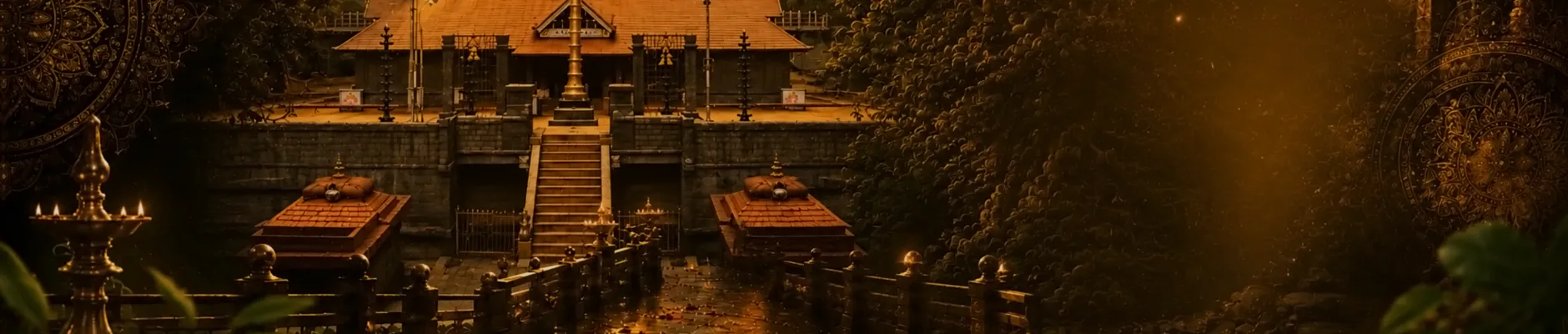
After the slaying of Mahishi, Sree Ayyappan, the embodiment of Sree Dharma Sastha, chose Sabarimala as his eternal abode, sanctifying it as a path of inner awakening for all seekers. In his boundless compassion for devotees undertaking this sacred pilgrimage, he entrusted Sree Vapura Swami, the Siva Bhootha, with a divine responsibility, not merely to protect, but to spiritually Page 12 of 19 SBSS – Sree Vapura Swami Web Content accompany each pilgrim from Kottappadi at Erumeli and guide them safely, peacefully, and with inner purity throughout their journey.
As time passed, this sacred duty of Sree Vapura Swami became less visible in the living traditions of the pilgrimage. Yet, divine will does not fade, it re-emerges when Dharma calls. In this era, that eternal responsibility has been rekindled and consciously entrusted to the Sree Bhoothanadha Seva Sangam.
This is not merely a service, but a spiritual vow, a seva rooted in surrender, discipline, and unwavering devotion. Guided by the grace of Sree Dharma Sastha, the Sangam assumes the sacred duty of embodying the protective presence of Sree Vapura Swami, ensuring that every devotee is not only safeguarded in body, but uplifted in spirit.
Through humility, vigilance, and divine remembrance, this mission seeks to transform the pilgrimage into a living spiritual experience, where each step becomes a movement toward truth, each challenge a purification, and each devotee is gently led toward union with the Supreme, Sree Dharma Sastha.